Squarespace vs static HTML: a real comparison

Most Squarespace vs HTML articles stay theoretical. This one doesn't. It's a site I rebuilt for LOH Made, Brenton Loh's Melbourne business making knives, spearguns and dive daggers. He'd been on Squarespace for a while, and the site did its job. It just didn't look or feel like him.
Here's the before and after, plus what changed beyond the looks.
The homepage


The Squarespace version is tidy enough: white background, standard menu, a photo with some text over it. The problem is that it could belong to almost any business. Nothing about it says "this bloke makes blades by hand and spends his weekends underwater."
The new homepage is dark and full-width, built around Brenton's own spearfishing photography. The LOH logo sits front and centre with his tagline, "From Depth and Summit," and you get the feel of the brand before you've read a word.
That's the main thing hand-coding buys you. I'm not squeezing content into a template's grid, so the layout can follow the brand instead of the other way round.
The about page

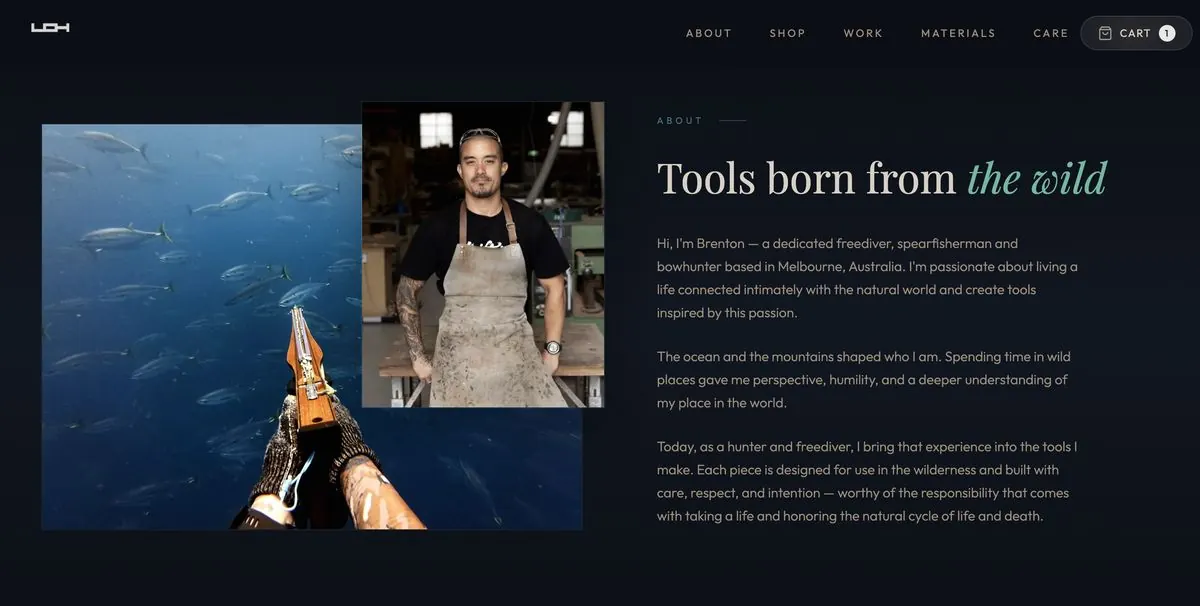
On Squarespace, the about page was the classic photo on the left, text on the right, on white. Brenton has a good story to tell (he's a freediver, spearfisherman and bowhunter who makes tools for the places he goes), and that layout wasn't doing it any favours.
The new version layers underwater photography behind his portrait under the heading "Tools born from the wild." It's the same story, but now the page looks like the world he's describing.
You can change colours and fonts on Squarespace, but the structure underneath stays theirs. Running a background photo behind a block of text, or layering images with any precision, is where you start fighting the editor.
Scrolling through both
Screenshots don't show what a site is like to move through. On the old site, each section is its own white block. On the new one, sections flow into each other and the photography carries you down the page.
What changed apart from the design
Speed. Every Squarespace site loads Squarespace's own scripts, fonts and shop code, whether it uses them or not. The rebuilt site only loads what each page needs, and it's noticeably quicker, especially on a phone.
Cost. Squarespace plans run about $16 to $33 a month, or $190 to $400 a year. A static site is hosted free on Cloudflare Pages, and the domain is about $25 a year. If you sell online, like LOH does, the shop runs on a small server and database, with payments handled by Square. Shops are priced on request.
Ownership. A Squarespace site lives on their platform and runs on their terms. If prices go up, you pay more, and if you leave, your design stays behind. A static site is a folder of files. It can be hosted almost anywhere, and any developer, or AI tool, can work on it. Every site from me is a flat $650, and you can choose to take that folder over after a 1:1 training session. If you'd rather not, I host and manage it for you.
SEO. Faster pages help, and so does clean code. On top of that, every page gets its own title, description, structured data and social preview, set up properly rather than squeezed into a platform's settings panel.
Updates. On Squarespace, you log in, find the right block and hope the formatting holds. With a static site from me, changes are free for the first 14 days after launch, then $50 per list. For everyday edits, I can set up an editable dashboard where you change your own text and images, while layout and design changes still come through me. Or I can spend a 45-minute session setting you up to make changes yourself by asking Claude, an AI assistant, in plain English.
When Squarespace still makes sense
If you've got hundreds of products with stock levels and shipping rules, or you need member logins, a platform like Shopify or Squarespace earns its keep. I'll tell you that if it's the case.
But most small businesses I talk to (studios, practitioners, tradies, makers, local clubs) need a site that looks like them, loads fast and makes it easy to get in touch or book. A hand-built static site does that better, and costs less to keep.
Where Brenton ended up
His old site was fine. It existed, and it showed his products. The new one looks like the work he makes, it's quicker, and it's no longer tied to a platform. His Google review put it better than I could: "Drew really understood the brief and delivered far beyond my highest expectations."
Squarespace pricing was checked in early 2026 and may have changed.